Stress can leave the body feeling tense and the mind unusually busy. A short yoga for stress relief routine offers one practical way to pause and move gently.
This 10-minute sequence combines comfortable breathing, simple poses, and a short rest. It is designed for home use and does not require advanced flexibility.
Yoga may support stress management for some people. It should not replace treatment for persistent anxiety, depression, trauma, or another health condition.
Quick Summary
- This routine takes about 10 minutes from start to finish.
- The sequence uses gentle poses and beginner-friendly modifications.
- Yoga may support perceived stress and general well-being for some people.
- Move within a comfortable range and avoid forcing stretches.
- Stop if you feel sharp pain, dizziness, numbness, or unusual symptoms.
Quick Facts
| Aspect | Details |
|---|---|
| Duration | 10 minutes |
| Experience | Beginner-friendly |
| Equipment | Mat optional; chair, cushion, or blocks may help |
| Main Focus | Gentle movement, breathing, and relaxation |
| Best Time | Any time that fits your routine |
| Main Limitation | Not a treatment for a mental health condition |
Who This Guide Is For
- ✔ Beginners looking for a short home yoga practice
- ✔ People who feel physically tense after a busy day
- ✔ Readers who want a simple mind-body stress management habit
- ✔ Anyone who prefers gentle movement over an intense workout
Can Yoga Help With Everyday Stress?
Research suggests that yoga may help some people manage perceived stress. The evidence does not mean every yoga session produces the same result.
The NCCIH review of yoga reports possible benefits for stress management, emotional health, sleep, and balance.
Studies use different yoga styles, session lengths, and participant groups. A 10-minute yoga for stress relief routine should therefore be viewed as supportive self-care.
The NCCIH stress overview also discusses breathing and relaxation techniques. Evidence for specific outcomes varies by method and population.
Healthy Pures Tip: Measure success by how manageable the practice feels. You do not need to feel instantly calm for the session to be worthwhile.
What Yoga For Stress Relief Can And Cannot Do
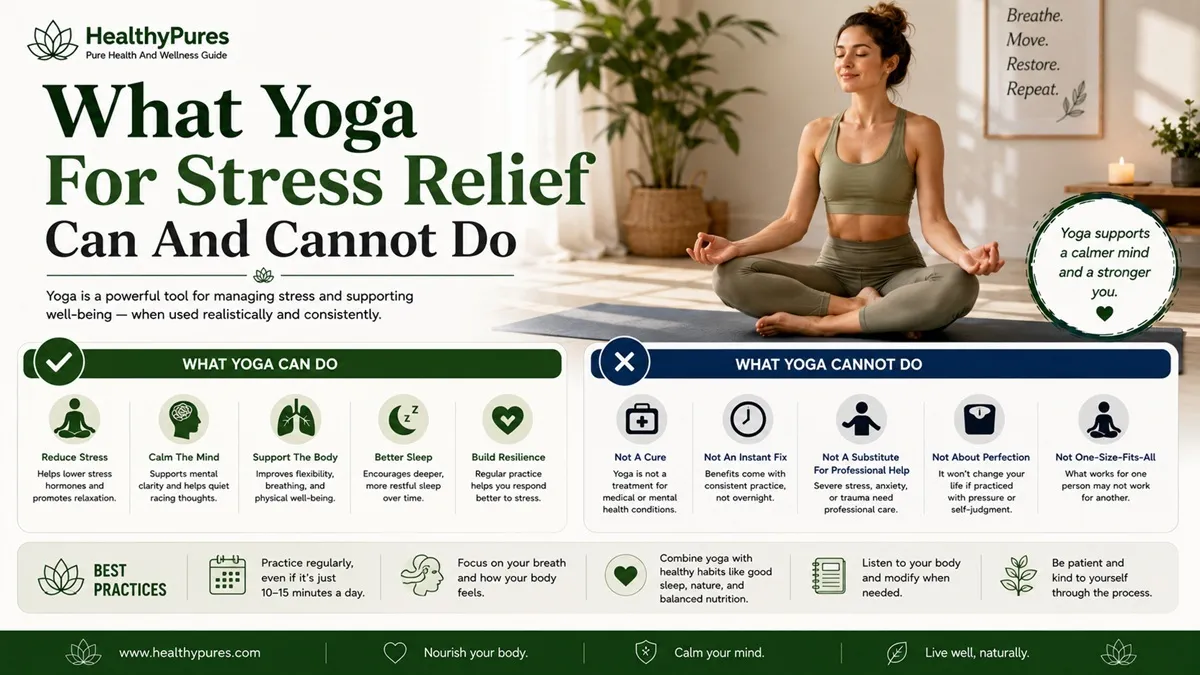
Yoga for stress relief may provide a structured period for movement, breathing, and focused attention. These elements can fit a broader stress management plan.
Yoga does not remove stressful circumstances. It also does not diagnose or treat an anxiety disorder, clinical depression, or post-traumatic stress disorder.
The NCCIH anxiety guidance notes that complementary approaches should not replace proven care.
If stress is persistent or interferes with daily life, consider speaking with a qualified healthcare or mental health professional.
Prepare For Your 10-Minute Routine
You only need enough floor space to move comfortably. A yoga mat can improve grip, but a stable carpeted area may also work.
Keep a chair, cushion, or blocks nearby if they make your yoga for stress relief practice more accessible. Turn off unnecessary notifications before you begin.
Essential oils, candles, and special music are optional. They are not required for the routine to be useful.
If you have an injury or medical condition, modify the sequence appropriately. Professional guidance may be useful when movement restrictions are unclear.
Your 10-Minute Yoga For Stress Relief Routine At A Glance
| Time | Movement | Main Focus |
|---|---|---|
| 0:00–1:00 | Comfortable Breathing | Settle and notice the breath |
| 1:00–2:30 | Cat-Cow | Gentle spinal movement |
| 2:30–4:00 | Supported Child’s Pose | Comfortable pause |
| 4:00–5:30 | Low Lunge | Gentle hip mobility |
| 5:30–7:00 | Supported Forward Fold | Back-body mobility |
| 7:00–8:30 | Supine Twist | Easy trunk rotation |
| 8:30–10:00 | Legs-Up-The-Wall Or Savasana | Quiet finish |
Yoga For Stress Relief: Steps 1–4
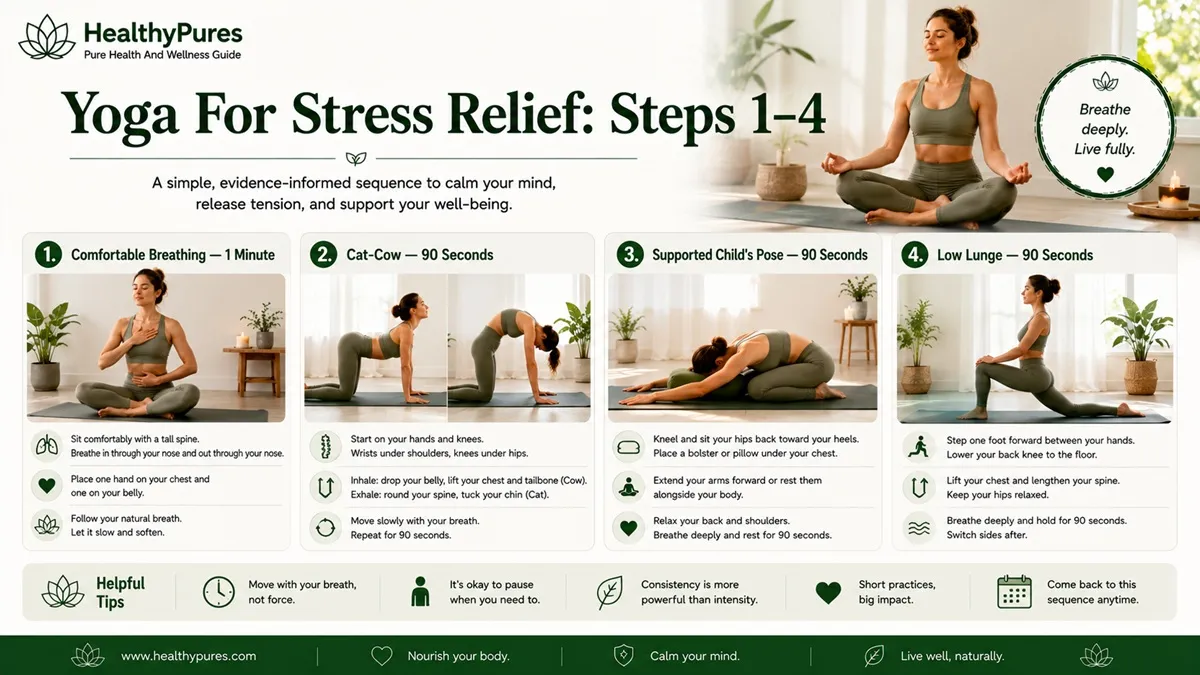
1. Comfortable Breathing — 1 Minute
Sit on a chair, cushion, or mat. Let your shoulders relax and keep your posture comfortable.
Breathe slowly without forcing a large inhale. Notice the rhythm of your breathing for about one minute.
Preliminary evidence suggests slow breathing may help with stress. However, individual responses vary.
Beginner modification: Keep your eyes open if closing them feels uncomfortable.
2. Cat-Cow — 90 Seconds
Come onto your hands and knees. Place your wrists near shoulder width and your knees near hip width.
On an inhale, gently lift your chest and soften your abdomen. On an exhale, slowly round your back.
Move at a comfortable pace. Keep the range smaller if your spine feels stiff.
This section of yoga for stress relief should feel controlled rather than forceful.
Beginner modification: Perform Cat-Cow while seated in a sturdy chair.
3. Supported Child’s Pose — 90 Seconds
From hands and knees, move your hips gently toward your heels. Keep your knees in a position that feels comfortable.
Rest your torso on a cushion if reaching the floor feels difficult. Your arms can extend forward or rest beside you.
Take several easy breaths without trying to deepen the pose. Leave the position if your knees or hips hurt.
Beginner modification: Use a chair and fold forward onto a cushion placed on a table.
4. Low Lunge — 90 Seconds
Bring one foot forward from hands and knees. Lower the opposite knee and use padding if needed.
Place your hands on the front thigh or blocks. Keep the stretch mild and your front foot stable.
Spend about 40 seconds on each side. Use the remaining time to change sides carefully.
A gentle lunge can add mobility to yoga for stress relief without requiring advanced flexibility.
Beginner modification: Hold a sturdy chair or keep both hands on blocks.
Yoga For Stress Relief: Steps 5–7
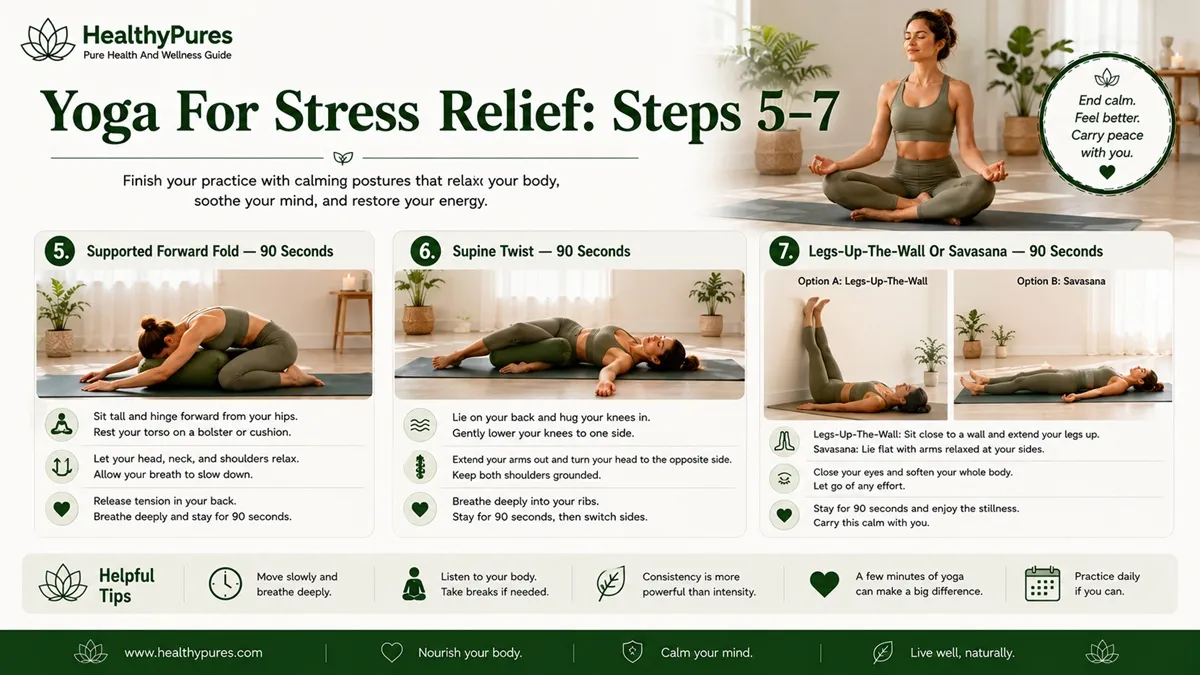
5. Supported Forward Fold — 90 Seconds
Stand with your feet in a stable position. Bend your knees slightly and hinge forward from your hips.
Rest your hands on your thighs, blocks, or a chair. Do not force your head toward your knees.
Keep your neck comfortable. Rise slowly if you feel lightheaded.
Beginner modification: Stay higher and place both hands on a chair seat.
6. Supine Twist — 90 Seconds
Lie on your back with your knees bent. Bring your knees gently toward one side.
Keep the twist comfortable and avoid pulling your legs farther with your hands. Return to center before switching sides.
Spend about 40 seconds on each side. Use the remaining time for the transition.
This yoga for stress relief sequence uses twisting only for comfortable movement. It does not “detox” the body or massage internal organs.
Beginner modification: Place a cushion beneath your knees to reduce the range.
7. Legs-Up-The-Wall Or Savasana — 90 Seconds
Choose the option that feels easiest. You do not need to perform an inversion to finish the routine.
For Legs-Up-The-Wall, rest your legs against a wall while lying comfortably. Move farther away if your hamstrings feel tight.
For Savasana, lie on your back with your arms relaxed. Bend your knees if that feels better for your lower back.
Let your breathing return to normal. This final pause completes your 10-minute yoga for stress relief practice.
Beginner modification: Sit in a supported chair and rest quietly instead.
Why This Routine Avoids Strong “Nervous System Reset” Claims
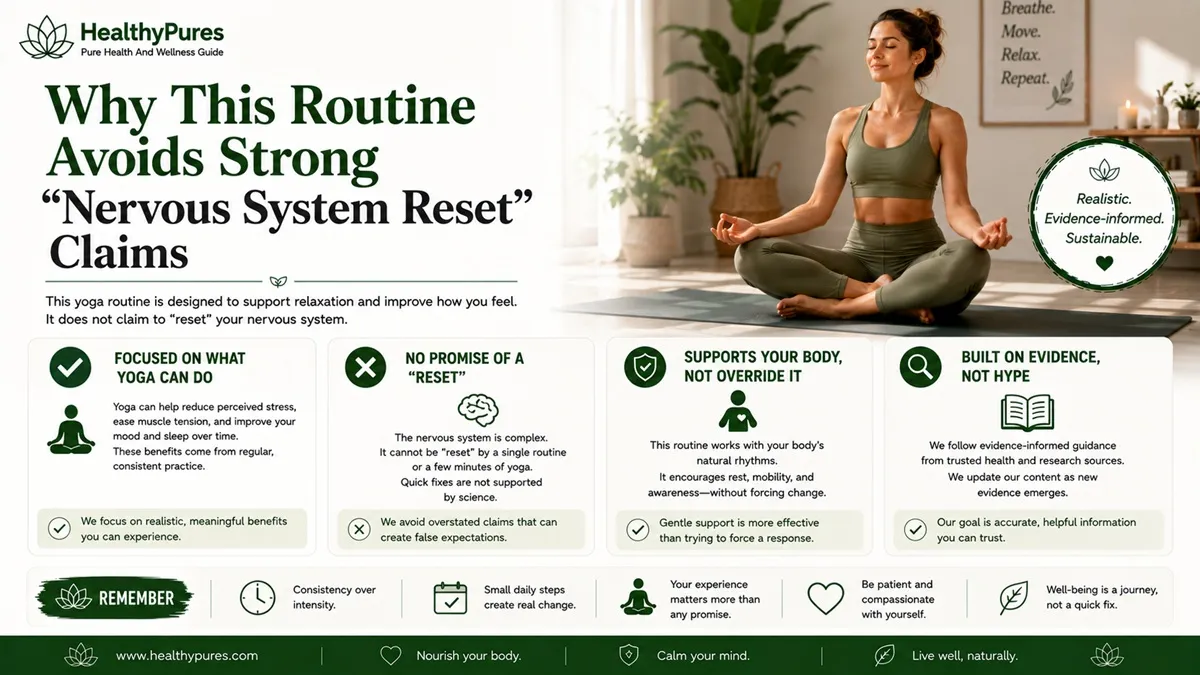
Online wellness content often describes yoga for stress relief as a way to “reset” the nervous system. That wording can oversimplify complex physiology.
Stress responses involve many systems, hormones, experiences, and individual factors. A short yoga routine cannot guarantee a specific nervous system state.
Slow breathing and relaxation practices may influence stress-related responses. The evidence is more nuanced than claiming a complete physiological reset.
Healthy Pures uses cautious wording. We avoid promising a cortisol drop or vagus nerve activation from one pose.
How Often Should You Practice?
There is no required schedule for yoga for stress relief. Choose a frequency that feels realistic and does not create pain or frustration.
Two or three short sessions each week can help you learn the sequence. Practice more often if it remains comfortable and useful.
Daily practice is optional. A sustainable routine is more valuable than forcing yourself to maintain a perfect streak.
For another short practice, try our 10-minute morning yoga routine for beginners.
Common Mistakes To Avoid
The biggest mistake with yoga for stress relief is turning a calming practice into another performance goal.
- Do not force stretches because a pose looks different in a photo.
- Do not hold your breath during uncomfortable movements.
- Do not assume pain means a pose is working.
- Do not use advanced inversions without appropriate instruction.
- Do not treat yoga as a replacement for mental health care.
The NCCIH yoga safety guidance notes that injuries can occur even though yoga is generally considered safe.
When To Modify Or Stop
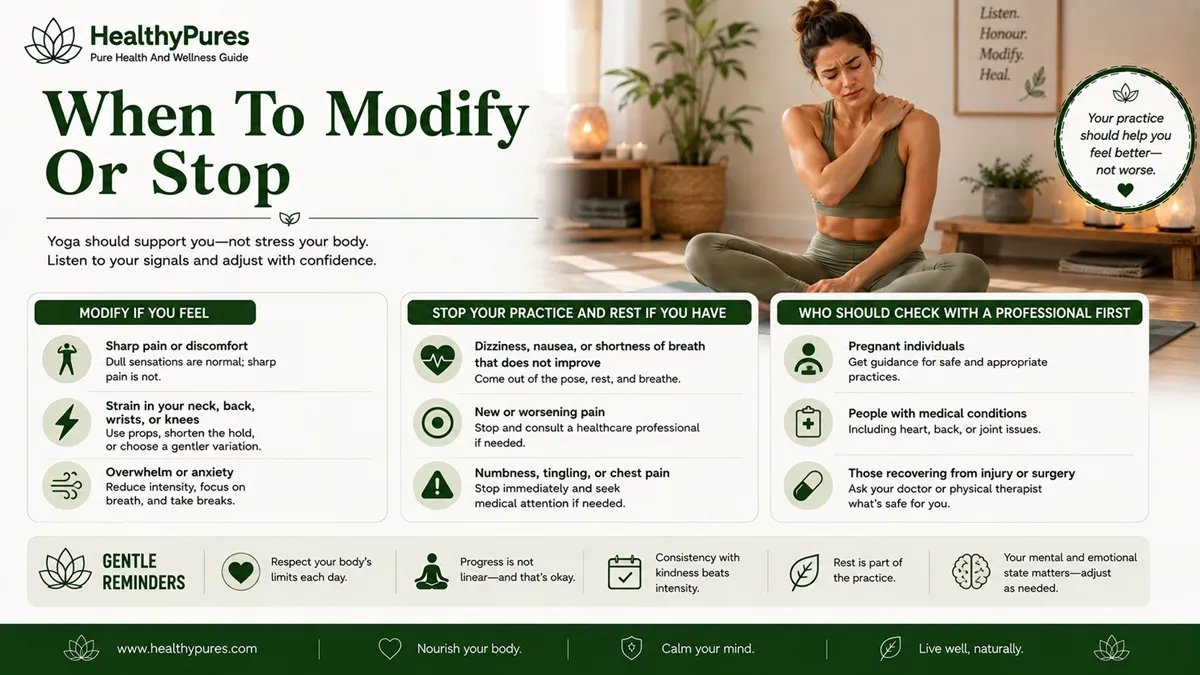
A yoga for stress relief routine should not cause sharp pain, faintness, severe breathlessness, or new neurological symptoms.
Stop if you experience these symptoms. Seek appropriate medical evaluation when symptoms are severe or persistent.
Pregnancy, balance problems, recent surgery, and some joint or spine conditions may require modifications. A qualified professional can help personalize movement.
Relaxation practices can occasionally feel uncomfortable for some people. The NCCIH relaxation techniques guidance notes that negative experiences can occur.
Build A Broader Stress Management Routine
Yoga for stress relief works best as one optional tool rather than the entire plan. Sleep, movement, social support, and professional care also matter.
Our simple stress relief activities provide additional low-pressure options.
You can also pair yoga with a brief mindfulness practice. See our daily meditation guide for more context.
If stress is disrupting sleep, our sleep schedule guide covers practical sleep habits.
Frequently Asked Questions
Can 10 Minutes Of Yoga Help With Stress?
A brief session may help some people feel more settled or physically comfortable. Research supports yoga as a possible stress management practice.
However, studies often examine programs longer than one 10-minute session. Results from a short yoga for stress relief routine will vary.
What Is The Best Yoga Pose For Stress Relief?
There is no single best pose for everyone. Comfortable breathing, supported Child’s Pose, and quiet rest are reasonable beginner options.
Choose positions that feel safe and manageable. A difficult pose is not automatically more effective.
Should I Practice Yoga Every Day?
No. Daily practice is optional.
Use yoga for stress relief as often as it fits your schedule and remains comfortable. Consistency does not require a seven-day routine.
Can Yoga Replace Anxiety Treatment?
No. Yoga may complement stress management, but it should not replace treatment for an anxiety disorder or another mental health condition.
Cognitive behavioral therapy and other evidence-based treatments may be more appropriate for persistent symptoms.
Can I Practice This Routine Before Bed?
Yes, if gentle movement feels comfortable before sleep. Keep the routine calm and avoid positions that make you feel more alert.
The NHLBI sleep guidance includes relaxation and stress management within broader healthy sleep strategies.
What If I Am Not Flexible?
Flexibility is not required. Use a chair, cushions, blocks, bent knees, and smaller ranges of motion.
The goal of yoga for stress relief is not to match a photograph. Comfortable movement is more important.
Conclusion
Yoga for stress relief can provide a simple 10-minute structure for breathing, movement, and a quiet pause at home.
This routine prioritizes comfortable positions, realistic timing, and beginner modifications. It avoids claims that one session can “reset” your nervous system.
Use yoga as one part of a broader stress management approach. Seek professional support when stress becomes persistent, severe, or difficult to manage.
This article provides general educational information and does not replace individualized medical or mental health care. Review our Medical & Affiliate Disclaimer for more information.