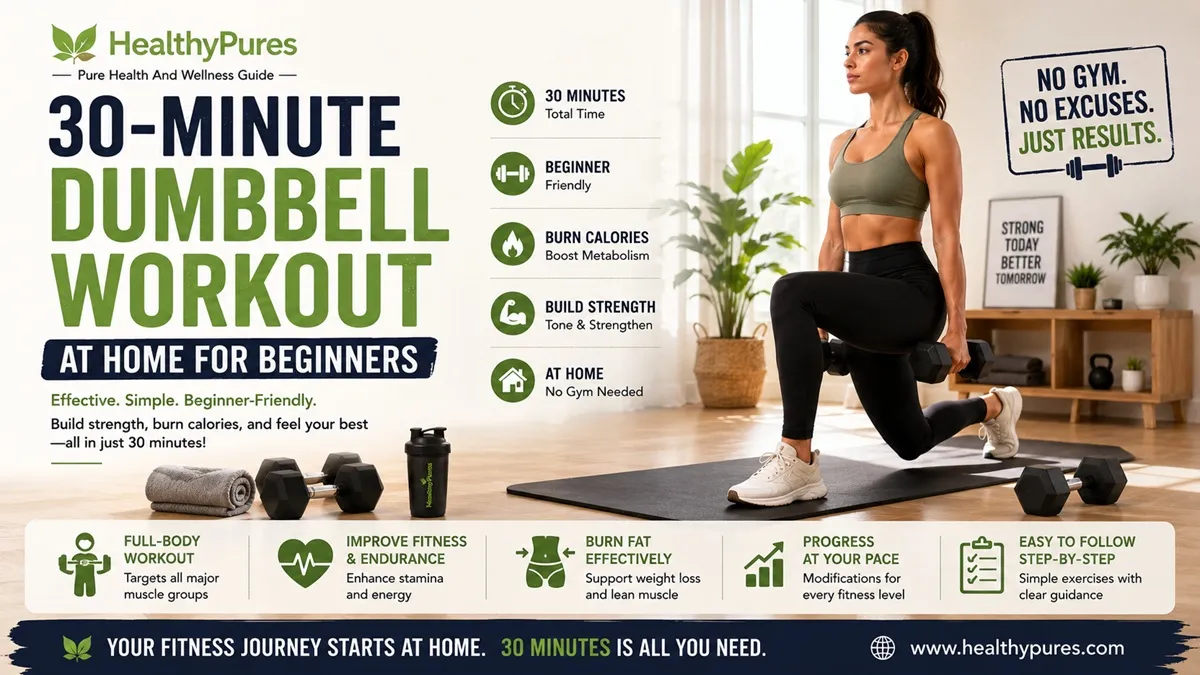
Starting strength training does not require a crowded gym or complicated equipment. A dumbbell workout at home for beginners can provide a simple way to learn basic movement patterns and build consistency.
This guide uses a realistic 30-minute structure with a warm-up, full-body strength circuit, and cool-down. If you prefer a no-equipment option, see our full-body home workout for beginners.
Quick Summary
- A dumbbell workout at home for beginners can train every major muscle group with minimal equipment.
- The routine uses about five minutes for warming up, 20 minutes for strength work, and five minutes for cooling down.
- Choose a weight that allows controlled repetitions without sacrificing form.
- Most beginners can start with two nonconsecutive strength sessions each week.
- Progress by adding small amounts of resistance, repetitions, or control over time.
Quick Facts
| Aspect | Practical Guideline |
|---|---|
| Workout Length | About 30 minutes |
| Equipment | One pair of dumbbells and an optional exercise mat |
| Beginner Frequency | Two nonconsecutive full-body sessions weekly is a practical starting point |
| Rep Range | Usually 8–12 controlled repetitions per exercise |
| Main Goal | Build basic strength, movement confidence, and consistency |
Who This Guide Is For
- ✔ Adults who are new to resistance training.
- ✔ People who want a simple full-body routine at home.
- ✔ Beginners with limited equipment or limited training time.
- ✔ Readers who want a structured plan instead of random exercises.
This dumbbell workout at home for beginners is written for generally healthy adults. People with injuries, chronic conditions, balance concerns, or unexplained symptoms should seek individualized guidance before starting.
Why Dumbbell Training Works Well For Beginners
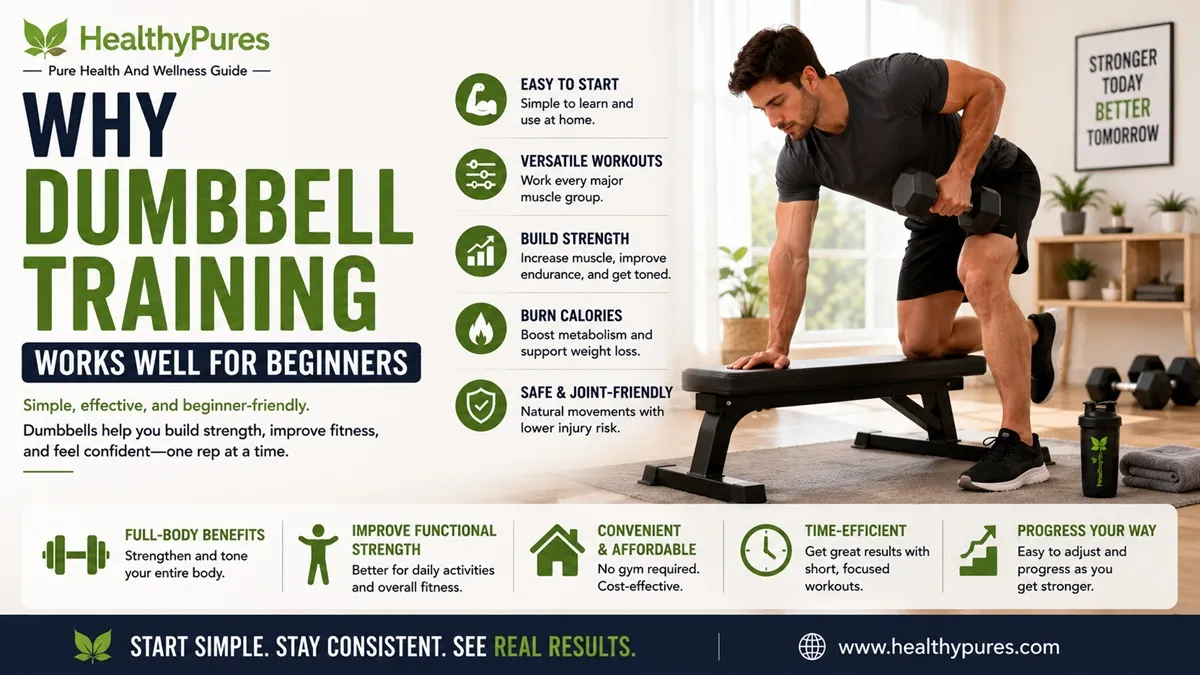
Dumbbells are flexible, compact, and easy to scale. They can train the legs, hips, back, chest, shoulders, arms, and core without requiring large machines.
The CDC adult activity guidelines recommend muscle-strengthening activity on at least two days each week. These sessions should involve the major muscle groups.
A dumbbell workout at home for beginners can help meet that strength-training goal. It can also support physical function when practiced consistently with appropriate resistance.
Essential Equipment For Your Home Workout
There is no universal beginner weight for a dumbbell workout at home for beginners. Your starting load depends on current strength and coordination.
That flexibility makes a dumbbell workout at home for beginners easier to adapt across different movements.
For this dumbbell workout at home for beginners, choose a load you can control for roughly 8–12 repetitions. The final repetitions should feel challenging without causing your form to collapse.
Healthy Pures Tip: Start lighter than you think you need. A slightly easier first session gives you room to learn the movements safely.
Before You Begin: Safety And Preparation

Good technique matters more than the number printed on a dumbbell. The Mayo Clinic weight-training guidance emphasizes controlled technique, appropriate resistance, breathing, and recovery.
Stop an exercise if you feel sharp pain, dizziness, chest pain, or unusual shortness of breath. Do not push through symptoms simply to finish the session.
A safe dumbbell workout at home for beginners should never require ignoring warning symptoms.
Warm-Up Routine
Spend about five minutes preparing for the dumbbell workout at home for beginners. Use movements that gradually increase body temperature and move the joints through comfortable ranges.
- 60 seconds of marching in place.
- 30 seconds of arm circles.
- 30 seconds of shoulder rolls.
- 60 seconds of bodyweight squats.
- 60 seconds of alternating reverse lunges or supported step-backs.
- 60 seconds of hip hinges without weight.
Mayo Clinic also recommends warming up before strength work. Their strength-training overview suggests several minutes of light aerobic movement before lifting.
Understanding Proper Form
During a dumbbell workout at home for beginners, move the weights deliberately. Keep breathing and reduce the load when technique deteriorates.
If you are uncertain about a movement, practice it without weight first. You can also review our home workout mistakes beginners should avoid.
30-Minute Workout At a Glance
This dumbbell workout at home for beginners schedule keeps the session genuinely close to 30 minutes. Beginners can extend transitions slightly if technique starts to feel rushed.
| Time | What to Do | Main Focus |
|---|---|---|
| 0:00–5:00 | Dynamic warm-up | Raise body temperature and rehearse movement patterns |
| 5:00–13:00 | Circuit 1: eight exercises | 8–12 controlled reps per movement |
| 13:00–14:00 | Rest and reset | Hydrate, adjust weights, and check form |
| 14:00–22:00 | Circuit 2: repeat eight exercises | Maintain the same technique and rep quality |
| 22:00–25:00 | Optional extra recovery or technique practice | Repeat one weak movement lightly, or rest |
| 25:00–30:00 | Easy cool-down | Walk, breathe normally, and stretch comfortably |
Beginner option: Complete only one circuit during the first week. Use the remaining time for technique practice and an easier cool-down.
The 30-Minute Dumbbell Workout At Home For Beginners

This dumbbell workout at home for beginners uses eight simple stations. Complete 8–12 controlled repetitions, then use the remainder of each minute to rest and move to the next exercise.
Perform all eight exercises once, rest for about one minute, then repeat the circuit. This creates roughly 18–20 minutes of strength work after the warm-up.
The structure keeps this dumbbell workout at home for beginners practical without rushing each exercise.
| Exercise | Target | Beginner Dose | Easier Modification |
|---|---|---|---|
| Dumbbell Squat | Quads, glutes, core | 8–12 reps | Bodyweight box squat |
| Reverse Lunge | Legs, glutes, balance | 6–10 reps per side | Supported step-back |
| Dumbbell Romanian Deadlift | Hamstrings, glutes, back | 8–12 reps | Shorter hip-hinge range |
| Bent-Over Dumbbell Row | Back, biceps | 8–12 reps | One-arm supported row |
| Dumbbell Floor Press | Chest, shoulders, triceps | 8–12 reps | Single light dumbbell press |
| Dumbbell Overhead Press | Shoulders, triceps | 8–12 reps | Seated neutral-grip press |
| Dumbbell Biceps Curl | Biceps | 8–12 reps | Alternating curls |
| Plank | Core | 20–40 seconds | Knee plank or elevated plank |
The CDC muscle-strengthening guidance notes that 8–12 repetitions can count as one set. More sets may provide additional benefit as capacity improves.
1. Dumbbell Squat
Hold the dumbbells at your sides or one dumbbell near your chest. Keep your feet comfortable, brace your trunk, and sit your hips back and down.
Stand by pressing through the whole foot. Only squat as low as you can while maintaining control.
Beginner modification: Sit back toward a sturdy chair or box, lightly touch it, then stand. Practice without dumbbells first if needed.
2. Dumbbell Reverse Lunge
Hold the dumbbells at your sides and step one foot backward. Lower under control while keeping the front foot stable.
Push through the front foot to return. Use a wall or sturdy chair for balance if needed.
Beginner modification: Perform a supported step-back with a shorter range. Remove the dumbbells until balance feels comfortable.
3. Dumbbell Romanian Deadlift
Hold the dumbbells in front of your thighs. Soften your knees and push your hips backward while keeping the weights close to your legs.
Stop when you feel tension through the hamstrings without rounding your back. Squeeze the glutes as you stand.
Beginner modification: Shorten the range and practice the hip hinge with very light dumbbells. Keep the weights close to your legs.
4. Bent-Over Dumbbell Row
Hinge at the hips with a neutral spine. Pull the dumbbells toward your lower ribs while keeping your shoulders away from your ears.
Lower the weights slowly. Avoid jerking the dumbbells upward with momentum.
Beginner modification: Support one hand on a sturdy bench or chair. Row one dumbbell at a time for greater stability.
5. Dumbbell Floor Press
Lie on your back with bent knees and dumbbells near chest level. Press upward until your arms are extended without forcefully locking the elbows.
Lower until your upper arms gently contact the floor. Keep your wrists stacked over your elbows.
Beginner modification: Use one light dumbbell in each hand and reduce the range if the shoulders feel uncomfortable.
6. Dumbbell Overhead Press
Stand or sit tall with the dumbbells near shoulder height. Brace your midsection and press upward without excessively arching your lower back.
If overhead pressing feels uncomfortable, reduce the weight or skip the movement. Pain is not a required part of progress.
Beginner modification: Sit on a stable chair and use a neutral grip. Stop before any painful range of motion.
7. Dumbbell Biceps Curl
Stand tall with your arms by your sides. Curl the dumbbells while keeping your elbows close to your torso.
Lower slowly and avoid swinging your body. The goal is controlled resistance rather than maximum weight.
Beginner modification: Curl one arm at a time. This reduces total demand and makes body position easier to control.
8. Plank
Place your forearms or hands on the floor and create a straight line through your trunk. Brace your core and squeeze your glutes.
Hold only while you can maintain a stable position. A plank from the knees is a useful beginner modification.
Beginner modification: Place your hands on a sturdy bench, table, or wall. A higher surface makes the plank easier.
How Often Should Beginners Do This Workout?

Most beginners can start the dumbbell workout at home for beginners twice each week. Leave at least one day between full-body strength sessions at first.
The Physical Activity Guidelines for Americans support muscle-strengthening work on at least two days weekly. Training frequency can increase gradually as recovery and experience improve.
How To Choose The Right Dumbbell Weight
The right load for a dumbbell workout at home for beginners feels challenging without forcing poor mechanics. Finish with control and some reserve.
If every set feels effortless, the dumbbells may be too light. If you cannot reach the target range with good form, reduce the resistance.
This approach makes a dumbbell workout at home for beginners easier to individualize. It is more useful than assigning the same starting weight to every person.
How To Progress Without Rushing
Progressive overload means increasing training demands gradually. You can add a repetition, increase resistance slightly, improve range of motion, or make each repetition more controlled.
Do not change everything at once. Keep the same dumbbell workout at home for beginners long enough to learn the movements and track improvement.
Small changes make a dumbbell workout at home for beginners easier to progress without losing technique.
Healthy Pures Tip: Reach the top of the rep range with consistent form. Then consider a small weight increase.
The National Institute on Aging describes gradual increases in training demands. Weight, sets, repetitions, or frequency can increase over time.
4-Week Beginner Progression Plan
A short progression plan can make a dumbbell workout at home for beginners easier to follow. Keep the exercises familiar while changing only one training variable at a time.
| Week | Plan | Progress Goal |
|---|---|---|
| Week 1 | One to two circuits, twice weekly | Learn technique and identify suitable weights |
| Week 2 | Two circuits, twice weekly | Reach the target rep range with consistent form |
| Week 3 | Two circuits, two or three times weekly | Add one or two reps where appropriate |
| Week 4 | Two circuits, two or three times weekly | Increase resistance slightly on movements that feel controlled |
There is no requirement to progress this dumbbell workout at home for beginners every week. Repeat a week when technique, recovery, or confidence needs more time.
Three Signs You Are Ready to Add Weight
- You can complete the top of the rep range without changing technique.
- The final repetitions feel controlled rather than unstable or rushed.
- You recover well before the next planned full-body session.
Common Mistakes To Avoid
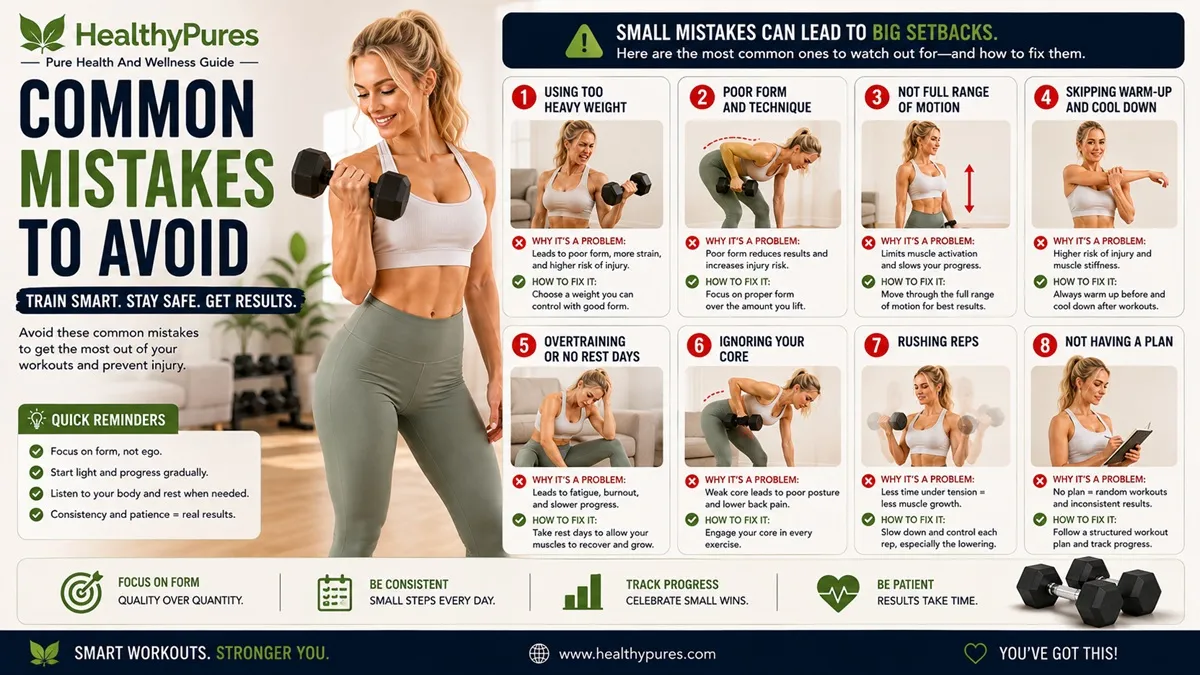
The most common mistake is choosing a weight that is too heavy. Beginners often compensate by shortening the range of motion, holding their breath, or using momentum.
Another mistake is turning the dumbbell workout at home for beginners into a race. Rest when needed and prioritize the quality of each repetition.
- Do not sacrifice form to complete more repetitions.
- Do not train through sharp or worsening pain.
- Do not increase weight every session automatically.
- Do not train the same full-body routine hard every day.
- Do not skip recovery because soreness feels like progress.
Cool-Down And Recovery
Finish the dumbbell workout at home for beginners with about five minutes of easy movement. Walk around the room and allow your breathing to return toward normal.
Gentle stretching can feel comfortable after training, but it does not need to be aggressive. Stretch the legs, hips, chest, shoulders, and back without forcing painful positions.
Hydration and Nutrition
Hydration supports a dumbbell workout at home for beginners and everyday body function. Drink according to thirst and individual needs.
Balanced meals can support recovery by providing protein, carbohydrates, fats, vitamins, and minerals. A workout does not require special detox drinks or supplements to be effective.
Recovery helps make a dumbbell workout at home for beginners more sustainable across the week.
Can This Workout Help With Weight Management?
A dumbbell workout at home for beginners can be one part of a weight-management plan. Resistance training helps preserve or build muscle while improving strength and physical function.
However, a single workout does not guarantee fat loss. Body weight changes depend on broader factors, including food intake, total activity, sleep, health conditions, medications, and individual circumstances.
That distinction is important because claims that dumbbells automatically “boost metabolism” can oversimplify weight management. Strength training is valuable without promising a specific scale result.
Frequently Asked Questions
How often should a beginner do dumbbell workouts?
Two full-body sessions on nonconsecutive days are a practical starting point. Some people may progress to three sessions as recovery improves.
Is a 30-minute dumbbell workout enough for beginners?
Yes. A focused 30-minute session can provide meaningful strength work. Train major muscle groups with appropriate resistance and good technique.
What weight dumbbells should a beginner use?
There is no single correct starting weight. Choose resistance that allows the planned repetitions with control while making the final repetitions moderately challenging.
Can I do this workout every day?
Daily full-body strength training is unnecessary for most beginners. Recovery days give trained muscles time to adapt before the next demanding session.
What if I cannot finish the full routine?
Complete one circuit instead of two, or reduce the repetitions. A shorter dumbbell workout at home for beginners with good form is better than forcing poor technique.
Starting Your At-Home Dumbbell Routine
A dumbbell workout at home for beginners should be simple enough to repeat consistently. This routine covers the major movement patterns without requiring complicated equipment.
Start conservatively, learn the exercises, and progress gradually. You can also use our beginner bodyweight exercise guide when you want an equipment-free session.
Disclaimer: This article provides general educational information and is not individualized medical or exercise advice. Stop exercising and seek appropriate medical care for concerning symptoms or injury.
Review our full Medical, Health & Affiliate Disclaimer for more information.