This guide keeps the original 30 prompts. It organizes them as one continuous list and adds practical guidance on choosing prompts, avoiding rumination, and knowing when journaling is not enough.
Quick Summary
- Journaling can help you organize thoughts, notice patterns, and reflect on difficult emotions.
- The most useful prompt depends on what you need: trigger awareness, emotional processing, positive attention, problem-solving, or self-compassion.
- A short, repeatable practice is often easier to maintain than forcing long entries.
- Stop or change the approach if writing makes you more overwhelmed or keeps you stuck in repetitive worry.
Quick Facts
| Aspect | Details |
|---|---|
| Main Purpose | Use writing to notice thoughts, emotions, patterns, triggers, and possible next steps. |
| Typical Session | There is no universally required duration; a short, focused session can be a practical starting point. |
| Research | Expressive writing shows modest average effects in some studies, but results vary by intervention and population. |
| Best Approach | Choose a prompt that matches your current need instead of forcing yourself to revisit painful material. |
| Possible Challenge | Writing may temporarily intensify difficult emotions or reinforce rumination for some people. |
| When To Get Help | Persistent or severe anxiety, major disruption to daily life, or thoughts of self-harm warrant professional support. |
Who This Guide Is For
- ✓ Adults who want a simple reflection tool for everyday stress or anxious thoughts.
- ✓ People who prefer structured questions instead of staring at a blank journal page.
- ✓ Anyone who wants to notice patterns in triggers, emotions, habits, or coping responses.
- ✓ Readers who understand that journaling can complement, but not replace, appropriate mental health care.
How Journaling May Help With Stress
Writing can create some distance between you and a busy stream of thoughts. Instead of holding every worry in your head, you can put the details on paper and decide what deserves attention now.
That does not mean every entry should focus on problems. Some people may find it more useful to identify what is within their control, record small positives, or write a compassionate response to themselves.
Research on expressive writing is more nuanced than the claim that journaling always reduces anxiety. The 2023 meta-analysis found a small overall effect on depression, anxiety, and stress symptoms. Effects were stronger at follow-up. That supports journaling as a possible self-help practice, not a guaranteed treatment. expressive writing findings.
A randomized trial of positive-affect journaling used 15-minute sessions three days each week for 12 weeks. The study reported lower mental distress and improved well-being, but it was a preliminary trial. Its schedule should not be treated as a universal prescription. positive-affect journaling trial.
Getting Started With Journaling
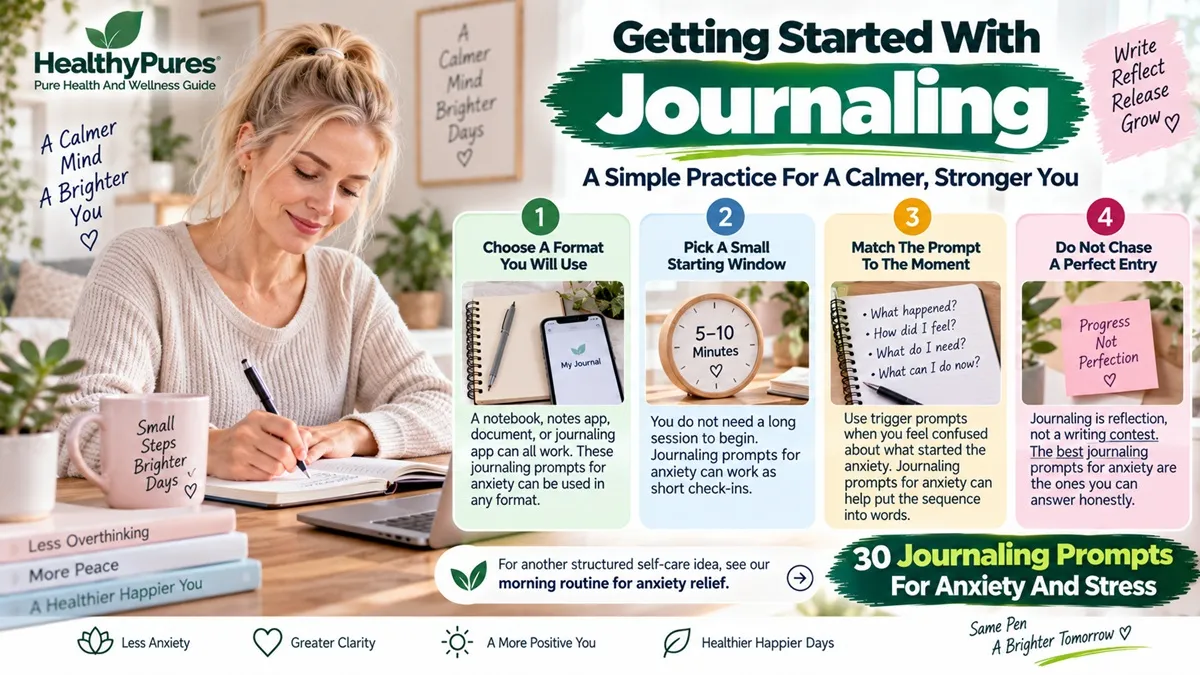
Choose A Format You Will Use
A notebook, notes app, document, or journaling app can all work. These journaling prompts for anxiety can be used in any format.
Pick A Small Starting Window
You do not need a long session to begin. Journaling prompts for anxiety can work as short check-ins.
Match The Prompt To The Moment
Use trigger prompts when you feel confused about what started the anxiety. Journaling prompts for anxiety can help put the sequence into words.
Do Not Chase A Perfect Entry
Journaling is reflection, not a writing contest. The best journaling prompts for anxiety are the ones you can answer honestly.
For another structured self-care idea, see our morning routine for anxiety relief.
30 Prompts To Explore Anxiety And Stress

These journaling prompts for anxiety are grouped by purpose. Each group supports a different kind of reflection.
Prompts 1–6: Identify Triggers
- When did I first notice this feeling of anxiety today, and what was happening just before it?
- What specific situations, people, or thoughts tend to precede my anxious feelings?
- Describe a recent time you felt stressed. What were the circumstances, and what did it feel like in your body?
- Are there any recurring themes or worries that appear when you feel anxious?
- What physical sensations do I associate with anxiety or stress? When do they typically arise?
- If my anxiety had a message for me, what would it be trying to communicate?
Prompts 7–12: Process Emotions
- What emotions am I feeling right now, and why do I think they are present?
- If I could give this emotion a color or shape, what would it be, and why?
- Describe how my current feelings are impacting my thoughts and actions.
- What is one feeling I’ve been avoiding, and what might happen if I allowed myself to notice it fully?
- What does my body need when I am experiencing this emotion?
- Write a letter to your anxiety or stress, expressing everything you want to say to it.
Prompts 13–18: Gratitude And Positive Attention
- List three small things that brought me joy or comfort today.
- What is one challenge I’ve overcome recently, and what did I learn from it?
- Who are three people I am grateful for, and why?
- What aspect of nature or my surroundings am I most appreciative of right now?
- Describe a simple pleasure that I often take for granted.
- If I look back at my day, what moments made me smile or feel a sense of peace?
Prompts 19–24: Future Planning And Problem-Solving
- What is one small step I can take tomorrow to address a current stressor?
- If I could imagine my ideal peaceful day, what would it look like?
- What resources or support systems do I have available when I feel overwhelmed?
- Identify one thing within my control that I can change about a stressful situation.
- What steps can I take to prepare for a potentially anxious event in the future?
- Write about a future scenario where I successfully manage a stressful situation. What strategies did I use?
Prompts 25–30: Self-Compassion And Acceptance
- What would I say to a friend who was feeling exactly what I’m feeling right now?
- Describe one strength or positive quality I possess that helps me cope.
- What is one way I can show myself kindness or gentle care today?
- Write about a time I felt proud of myself for handling a difficult emotion.
- What past experiences have taught me resilience, and how can I draw on that now?
- How can I offer myself understanding and acceptance, even when I’m struggling?
How To Choose The Right Prompt
If your mind feels scattered, start with a trigger prompt. These journaling prompts for anxiety can help organize what happened.
If you know the trigger but feel emotionally stuck, choose a processing or self-compassion prompt. Journaling prompts for anxiety can give that reflection some structure.
When a problem has a practical solution, move to a planning prompt. Some journaling prompts for anxiety work best when they end with one action.
When your attention is locked onto threat, a gratitude or positive-attention prompt can give your journal a different direction. These journaling prompts for anxiety do not need to deny difficult feelings.
A Simple 10-Minute Journaling Routine
| Time | What To Do |
|---|---|
| Minute 1 | Name the emotion or main source of stress. |
| Minutes 2–4 | Answer one prompt without editing yourself. |
| Minutes 5–7 | Separate what you can control from what you cannot. |
| Minutes 8–9 | Choose one realistic next step or one act of self-care. |
| Minute 10 | Write one sentence about what you want to remember from the session. |
This routine is intentionally short. It gives journaling prompts for anxiety a simple place in a busy day.
When Journaling Starts To Feel Like Rumination
Not every form of writing is helpful in every moment. If you repeatedly rewrite the same worry or list possible disasters, the journal may reinforce the loop.
Change the prompt when that happens. Some journaling prompts for anxiety are better suited to planning than repeated emotional replay.
Ask what is within your control, what information you actually have, or what small action could help today. You can also stop writing and shift to another grounding activity. grounding techniques for anxiety can offer other options.
Research does not support treating one expressive-writing session as a guaranteed anxiety treatment.
A 2026 meta-analysis of single-session expressive writing for test anxiety found a negligible, nonsignificant effect on anxiety overall. The result is specific to test anxiety, but it is still a useful reminder that one writing session may not work for everyone. single-session writing meta-analysis.
How Often Should You Journal?

There is no universal schedule everyone needs to follow. One randomized trial used 15-minute sessions three days per week. That was a study protocol, not a rule for daily life. study writing schedule.
A practical approach is to choose a pattern you can repeat. Your journaling prompts for anxiety can stay flexible from week to week.
When To Seek Professional Support
Journaling can be a self-help practice, but persistent anxiety that interferes with sleep, work, relationships, or daily tasks may need more support.
NIMH advises seeking professional help when severe or distressing symptoms last two weeks or more or make it difficult to complete usual activities. NIMH mental health guidance.
Mental health professionals can help you identify appropriate treatment and coping strategies. NIMH also provides information about anxiety disorders and how to find help. NIMH anxiety information.
If you are having thoughts of suicide or urges to hurt yourself, journaling should not be your only support. In the United States, call or text 988 for the Suicide & Crisis Lifeline, or call 911 in a life-threatening emergency. NIMH crisis guidance.
FAQ
Can Journaling Reduce Anxiety?
It may help some people, but the evidence is mixed and average effects are modest. A meta-analysis of expressive writing found a small overall effect across depression, anxiety, and stress outcomes. Journaling is better viewed as one possible self-help tool than a guaranteed treatment. meta-analysis findings.
How Long Should I Journal For Anxiety?
There is no required duration. Journaling prompts for anxiety can be used for a short session or a longer reflection.
What Should I Write About When I Feel Overwhelmed?
Start with a simple question. Journaling prompts for anxiety do not need complicated instructions.
Can Journaling Make Anxiety Worse?
It can temporarily increase difficult emotions for some people, especially when writing becomes repetitive or focuses intensely on painful experiences. Change the prompt, shorten the session, or stop if the practice consistently makes you feel worse.
Is Journaling A Substitute For Therapy?
No. Journaling may complement other forms of care, but persistent or severe anxiety may require professional assessment and treatment.
Should I Journal Every Day?
No. A daily schedule is not required. Journaling prompts for anxiety can be used when they are genuinely useful to you.
The Bottom Line
Journaling prompts for anxiety can make reflection easier because you do not have to invent a question while you are already stressed.
The most useful prompt matches your current need. You might identify a trigger, process an emotion, solve one small problem, notice something positive, or practice self-compassion.
Keep the practice simple, stay curious about your patterns, and change course when writing turns into repetitive worry. Journaling can be part of a broader wellness routine, but it should sit alongside appropriate professional support when anxiety becomes persistent, severe, or disruptive.
Just a friendly reminder from our team: Health needs vary from person to person, so this information is intended to support general wellness and does not replace professional medical advice. Read our full Medical Disclaimer for more information.