The goal is not to complete every movement at once.
Start with exercises you can perform with control, keep the range of motion comfortable, and progress gradually.
Older adults are encouraged to include muscle-strengthening and balance activities each week. The amount should match their abilities and health conditions.
CDC older-adult activity guidance .
Quick Summary
- Chair-based movements can make strength and mobility work more accessible when standing exercise is difficult.
- Choose a sturdy, non-rolling chair and place it on an even, uncluttered surface.
- Start with controlled repetitions and light resistance, then increase the challenge gradually as your form improves.
- Stop for sharp pain, unusual shortness of breath, dizziness, chest pain, or another concerning symptom.
Quick Facts
| Aspect | Details |
|---|---|
| Who It Fits | Older adults who want adaptable strength, mobility, or seated movement options. |
| Basic Equipment | A sturdy chair without wheels; optional light hand weights or a resistance band. |
| Strength Frequency | Older adults should include muscle-strengthening activity on at least 2 days each week. |
| Starting Point | Begin with a manageable number of repetitions and light resistance when appropriate. |
| Progression | Increase repetitions, sets, range of motion, or resistance gradually rather than all at once. |
| Safety | Use stable support, move with control, and seek professional guidance when a movement is unclear or symptoms occur. |
Who This Guide Is For
- ✓ Older adults who want simple strength exercises that can be modified for seated practice.
- ✓ People who find some standing exercises difficult but can safely sit and move their limbs.
- ✓ Beginners looking for a low-equipment routine they can build gradually.
- ✓ Caregivers who want general exercise ideas to discuss with an older adult and, when needed, a health professional.
Why Chair Exercises Can Be Useful For Older Adults
For many older adults, chair exercises for seniors can make structured movement easier to approach.
Physical activity supports healthy aging. Older adults benefit from aerobic, muscle-strengthening, and balance activities. Strength work can help maintain physical function, while balance activities can support stability and help reduce fall-related injury risk. NIA exercise guidance . Harvard chair exercise guidance.
Not every chair exercise trains the same quality. A seated leg extension is mainly a lower-body movement, while a band row works the back and arms. Mobility drills can support range of motion but should not be described as strength exercises unless they provide enough resistance.
That distinction helps you use chair exercises for seniors realistically. The chair is a tool for accessibility, not a guarantee that every movement is appropriate for every person.
Before You Start: Safety Setup

A safety-first approach is essential when choosing chair exercises for seniors.
Choose A Stable Chair
A stable setup is especially important for chair exercises for seniors.
Use a sturdy chair that does not roll or slide. Place it on a firm, level surface with enough room around it to move your arms and legs without striking furniture. Cleveland Clinic chair exercise guidance.
Keep Your Feet And Posture Stable
Good positioning makes chair exercises for seniors easier to control.
For seated exercises, keep your feet supported when the movement allows it. Sit tall without forcing your spine into an exaggerated position. Avoid leaning or twisting just to complete a repetition.
Start With Less Resistance
Beginners can use lighter resistance for chair exercises for seniors.
For beginners, bodyweight or very light resistance can be enough. NIA guidance recommends becoming comfortable with movements before adding weights or resistance bands. NIA strength-training guidance.
Know When To Stop
These safety rules apply to chair exercises for seniors as much as any other workout.
Stop the exercise for chest pain, fainting, unusual shortness of breath, or severe dizziness. Seek appropriate medical advice for a symptom that feels abnormal for you.
15 Chair Exercises To Build Strength Safely
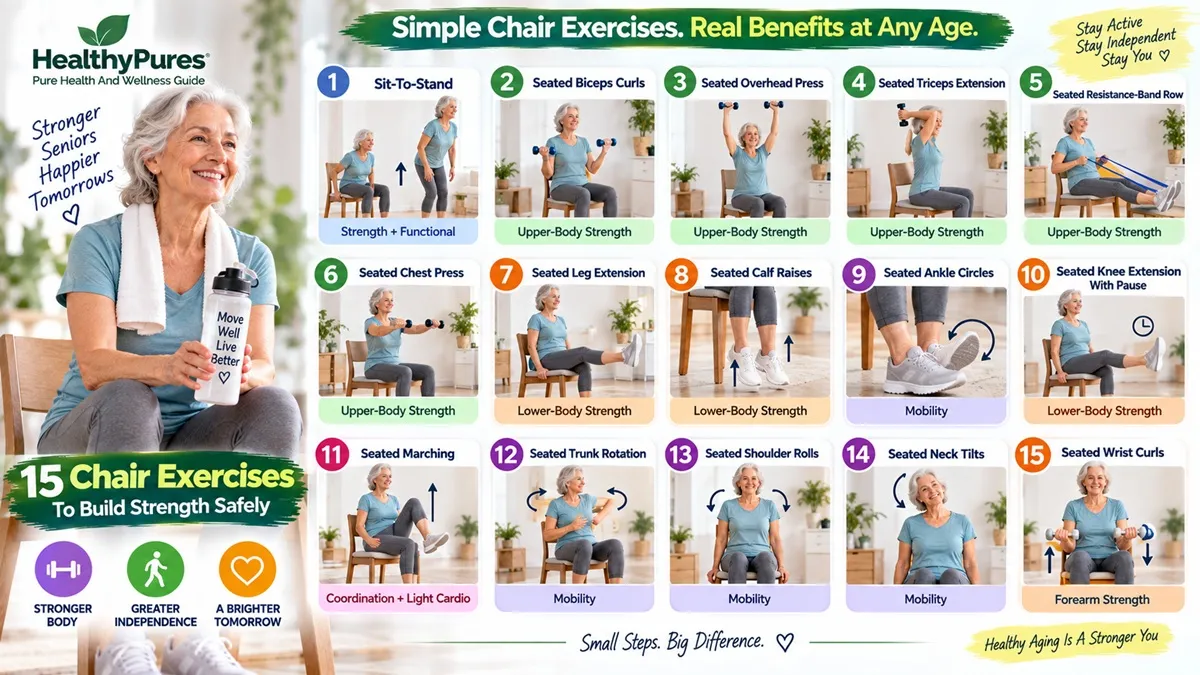
This chair exercises for seniors list mixes strength, mobility, and coordination.
These chair exercises for seniors cover strength, mobility, and coordination. You do not need to perform all 15 in one session. Choose a small group that fits your goals and ability.
1. Sit-To-Stand
Sit-to-stand is one of the most functional chair exercises for seniors.
Primary Focus: Strength + Functional Movement
Sit near the front of a sturdy chair with your feet about hip-width apart. Lean forward slightly from your hips while keeping your chest lifted. Press through your feet to stand, then slowly lower back toward the chair.
Use the chair mainly as a target and support point. If standing without using your hands is not safe, modify the movement or get professional guidance before practicing it.
2. Seated Biceps Curls
Biceps curls are simple chair exercises for seniors for upper-body strength.
Primary Focus: Upper-Body Strength
Sit tall with a light weight in each hand, or use two light household objects with secure grips. Keep your elbows close to your sides and bend your arms to bring your hands toward your shoulders.
Lower slowly instead of letting the weights drop. Choose resistance that allows you to keep your shoulders relaxed and your wrists controlled.
3. Seated Overhead Press
An overhead press can be adapted within chair exercises for seniors when shoulder comfort allows.
Primary Focus: Upper-Body Strength
Hold light weights at shoulder level with your palms facing forward or slightly inward. Press upward only through a comfortable range, then return to shoulder height with control.
Keep your ribs and lower back from arching excessively. Skip overhead pressing or ask a qualified professional for a modification when shoulder problems make the movement uncomfortable.
4. Seated Triceps Extension
Triceps extensions add another upper-body option to chair exercises for seniors.
Primary Focus: Upper-Body Strength
Hold one light weight with both hands above your head if this position feels comfortable. Keep your upper arms relatively still as you bend your elbows and lower the weight behind your head.
Extend your elbows to return to the starting position. Use very light resistance and avoid forcing the movement if your shoulders or elbows are painful.
5. Seated Resistance-Band Row
Band rows expand chair exercises for seniors with a pulling movement.
Primary Focus: Upper-Body Strength
Loop a resistance band securely according to the manufacturer’s instructions, or use an appropriate fixed anchor designed for the band. Sit tall and pull the band toward your torso while drawing your shoulder blades gently together.
Return slowly. Avoid jerking the band or wrapping it around a part of the chair that could move or break.
6. Seated Chest Press
A chest press adds a controlled pushing pattern to chair exercises for seniors.
Primary Focus: Upper-Body Strength
Hold light weights near chest level with your elbows bent. Press your hands forward through a comfortable range, then bring them back slowly.
Keep your shoulders down instead of shrugging. Start with very light resistance so you can control both the press and the return.
7. Seated Leg Extension
Leg extensions are useful chair exercises for seniors for the front of the thighs.
Primary Focus: Lower-Body Strength
Sit upright with your feet supported. Straighten one knee until your lower leg is lifted comfortably, pause briefly, then lower it with control. Alternate sides.
This movement can challenge the muscles at the front of the thigh. Do not force your knee into a hard lock, especially if you have a knee condition.
8. Seated Calf Raises
Calf raises are simple chair exercises for seniors for lower-leg strength.
Primary Focus: Lower-Body Strength
Place both feet flat on the floor. Lift your heels while keeping the balls of your feet down, then lower slowly. Repeat for several controlled repetitions.
You can also lift the forefoot while keeping your heels down. Use the version that feels stable and comfortable.
9. Seated Ankle Circles
Ankle circles can complement chair exercises for seniors when mobility is the priority.
Primary Focus: Mobility
Lift one foot slightly if you can do so safely. Slowly draw circles with your ankle in one direction, then reverse the direction. Switch sides.
This is primarily a mobility exercise rather than a strength exercise. Keep the movement small if a larger circle feels uncomfortable.
10. Seated Knee Extension With Pause
This knee-extension variation can be another option within chair exercises for seniors.
Primary Focus: Lower-Body Strength
Sit tall and extend one lower leg until the knee reaches a comfortable range. Hold briefly, then return the foot toward the floor.
For an easier option, use a smaller range of motion and fewer repetitions. Keep the movement smooth rather than kicking the leg outward.
11. Seated Marching
Seated marching adds a light conditioning element to chair exercises for seniors.
Primary Focus: Coordination + Light Cardio
Sit tall and lift one knee a few inches, then lower it and switch sides. Continue in a controlled alternating pattern.
Keep your torso as steady as you can. Reduce the height of the knee lift when balance, hip mobility, or comfort is limited.
12. Seated Trunk Rotation
Gentle trunk rotation can complement chair exercises for seniors focused on mobility.
Primary Focus: Mobility
Sit with your feet supported and your hands resting comfortably. Slowly rotate your upper body a small amount to one side, return to center, and repeat on the other side.
Do not force the rotation or turn quickly. A smaller movement is often more appropriate than trying to reach a large range.
13. Seated Shoulder Rolls
Primary Focus: Mobility
Sit comfortably and gently lift your shoulders, move them back, then let them settle down. Repeat in a slow circular pattern, then reverse the direction if comfortable.
This is a mobility drill, not a heavy strengthening exercise. Keep the circles smooth and avoid shrugging forcefully.
14. Seated Neck Tilts
Primary Focus: Mobility
Sit upright and slowly tilt your head so one ear moves toward the same-side shoulder. Return to the center and switch sides.
Keep the movement gentle. Do not pull your head with your hand, bounce into the stretch, or continue if the movement causes pain, dizziness, or unusual symptoms.
15. Seated Wrist Curls
Primary Focus: Forearm Strength
Rest your forearms on your thighs while holding very light weights, with your wrists extending slightly past your knees when practical. Curl the wrists upward and lower them slowly.
Turn your palms downward for a reverse variation if it feels comfortable. Use minimal resistance and keep the movement controlled.
How To Build A Simple Weekly Routine
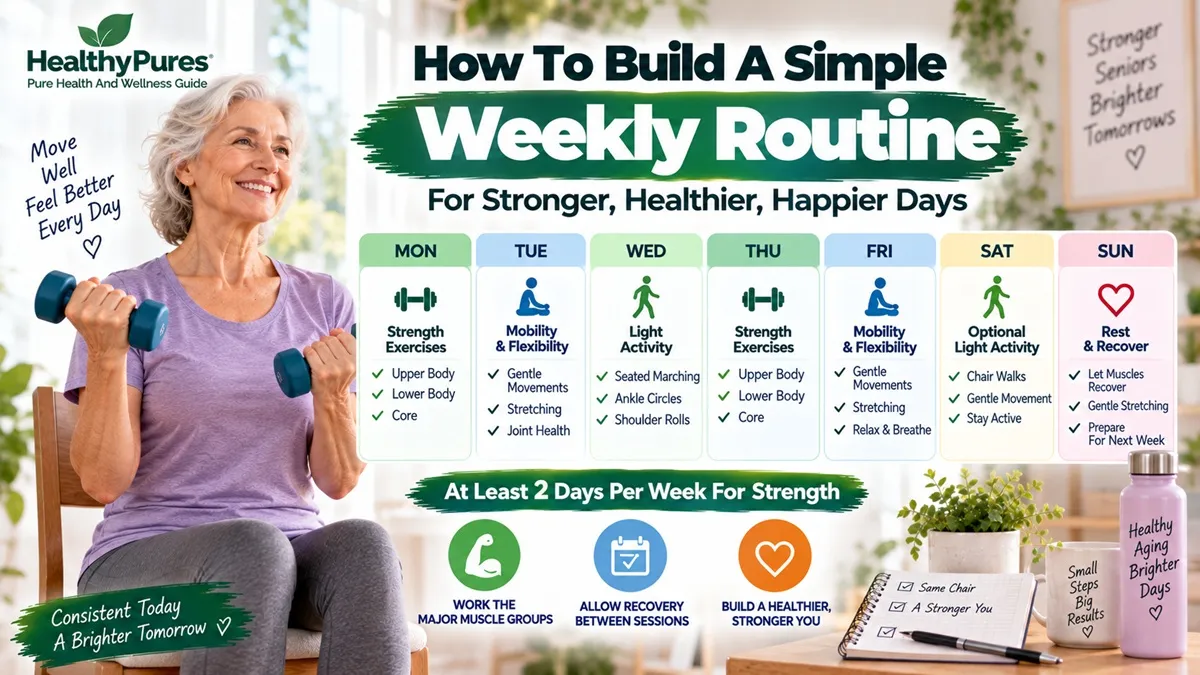
A simple weekly structure can make chair exercises for seniors easier to repeat consistently.
You do not need to perform all 15 exercises every day. For strength-focused work, older adults should include muscle-strengthening activity on at least 2 days each week. NIA also recommends working the major muscle groups and allowing recovery between sessions for the same muscle groups. NIA weekly strength guidance.
| Day | Example Focus |
|---|---|
| Monday | Lower body: sit-to-stand, leg extension, calf raises, seated marching. |
| Tuesday | Light walking or another comfortable aerobic activity. |
| Wednesday | Upper body: curls, chest press, row, triceps extension. |
| Thursday | Gentle mobility such as ankle circles, shoulder rolls, and neck tilts. |
| Friday | Full-body session using a smaller selection from the 15 exercises. |
| Weekend | Walking, balance work, flexibility, or recovery based on your needs. |
The CDC recommends aerobic, muscle-strengthening, and balance activities for adults 65 and older. The amount should match individual abilities and conditions.
How Many Repetitions Should Seniors Do?
A practical starting point for many strengthening movements is 8–12 repetitions. NIA notes that one set of 8–12 repetitions can be effective, while additional sets may provide more benefit. Beginners can start without weights or bands until they are comfortable with the movements. NIA repetition guidance.
Do not treat 8–12 as a mandatory target. Some people may need fewer repetitions, a smaller range of motion, lighter resistance, or longer rest periods. home strength training without weights.
How To Progress Safely
Gradual progression is what makes chair exercises for seniors useful beyond the first few weeks.
Progress one variable at a time. Add a few repetitions first. Then consider another set or slightly more resistance.
NIA safety guidance recommends normal breathing during strength exercises and avoiding locked joints. Seek advice from a doctor or physical therapist when a movement is unclear. NIA exercise safety tips .
When To Get Professional Guidance
Recent surgery, serious balance problems, uncontrolled symptoms, significant joint pain, or limited exercise tolerance may require an individualized plan.
If you are unsure whether a particular movement is appropriate, a doctor or physical therapist can help you choose modifications. NIA specifically recommends professional guidance when an older adult is unsure how to perform a movement or has difficulty with balance. NIA safety advice.
Stop And Seek Medical Help For Concerning Symptoms
Stop exercising and seek appropriate medical care for chest pain, fainting, severe shortness of breath, sudden weakness, or another serious symptom. New neurological symptoms or severe pain also warrant prompt evaluation.
Do not try to push through a warning sign simply because an exercise is described as low impact. Low impact does not mean risk free.
FAQ
Can Seniors Do Chair Exercises Every Day?
Gentle mobility exercises may fit into daily movement for some people. Strength-focused sessions are different. Give the muscles recovery time between challenging sessions, especially when resistance is added.
Do Chair Exercises Build Strength?
They can, when the movement provides enough resistance or challenge. Some chair movements are mainly for mobility or coordination. For strength gains, select movements that challenge the target muscles and progress gradually.
What If I Cannot Stand Without Help?
Many seated movements can still train the upper and lower body. A physical therapist or other qualified professional can help choose appropriate options.
Can Chair Exercises Help With Balance?
They can contribute to strength and coordination, but seated exercise alone does not fully replace balance practice. Older adults should include balance activities appropriate to their abilities. Use support such as a sturdy chair or wall when needed. NIA balance guidance.
Do I Need Weights?
No. Beginners can start with bodyweight movements or no added resistance. Light weights or bands can be added later when you can perform the movement safely and with good control.
How Long Should A Chair Exercise Session Last?
There is no single required duration. Start with a manageable session that includes a brief warm-up and enough rest. Build duration gradually as your tolerance improves rather than chasing a fixed 30-minute target.
Are Chair Exercises Good For Weight Loss?
They can contribute to overall physical activity and muscle strengthening, but they should not be presented as a stand-alone weight-loss solution. Nutrition, total activity, sleep, health conditions, and other factors all influence body weight.
The Bottom Line
The best chair exercises for seniors are the ones you can perform safely, consistently, and with enough challenge to match your current ability.
The 15 movements above mix strength, mobility, and coordination work. Select the exercises that fit your needs instead of doing everything at once.
Start with a stable chair, light resistance, controlled movement, and a realistic schedule. As you become more comfortable, progress gradually. Older adults benefit from strength work, aerobic activity, and balance practice across the week. CDC older-adult activity guidance .
For more at-home training ideas, see our home strength training guide.
Just a friendly reminder from our team: Health needs vary from person to person, so this information is intended to support general wellness and does not replace professional medical advice. Read our full Medical Disclaimer for more information.