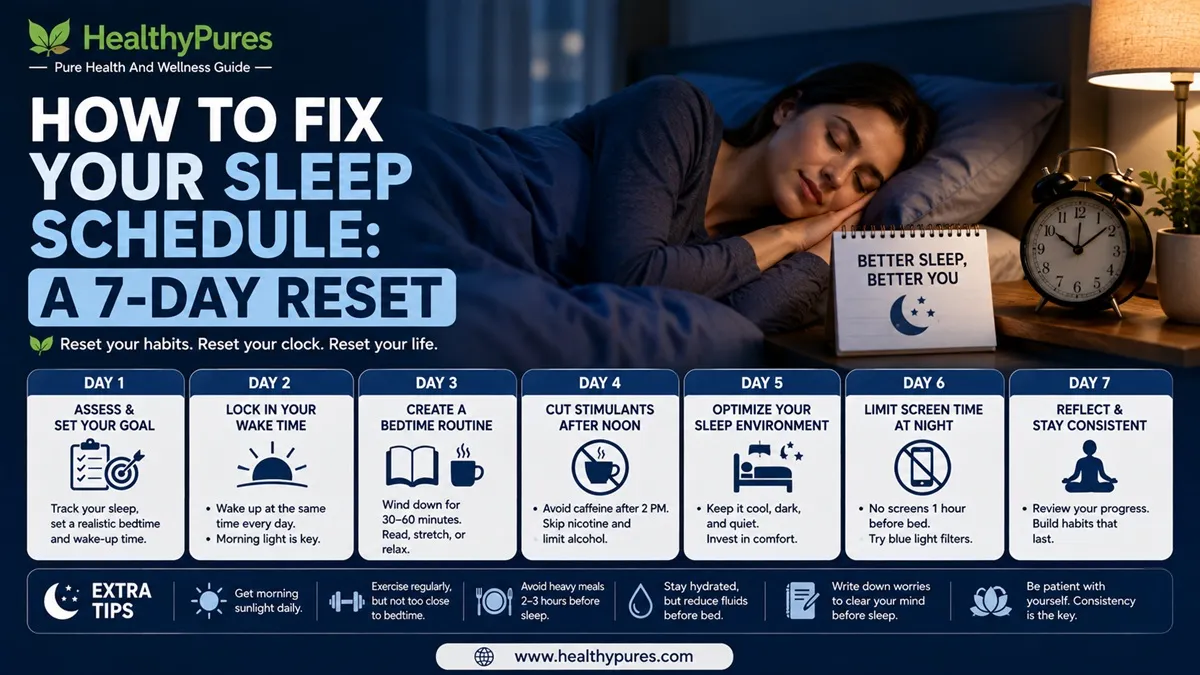
Learning how to fix your sleep schedule starts with consistency, not forcing yourself to fall asleep on command. Your sleep-wake rhythm responds to timing, light, activity, caffeine, and everyday routines.
This seven-day reset can help you build a more predictable schedule. For how to fix your sleep schedule, treat the week as a starting point rather than a guaranteed deadline.
Quick Summary
- Choose a consistent wake time and keep it as steady as possible.
- Use daytime light and a calmer evening environment to reinforce sleep-wake timing.
- Move bedtime gradually when your current schedule is far from your target.
- Limit late caffeine, large meals, alcohol, and bright artificial light before bed.
- Seek professional guidance when sleep problems are persistent, severe, or linked with daytime impairment.
Quick Facts
| Aspect | What To Know |
|---|---|
| Adult Sleep Need | Adults ages 18–60 generally need at least 7 hours daily. |
| Short Sleep In 2024 | 30.5% of U.S. adults reported less than 7 hours on average. |
| Strong Circadian Cue | Light is a major environmental signal for the sleep-wake cycle. |
| Caffeine Timing | Its effects can last for hours and may interfere with sleep. |
| Seven-Day Goal | Build a steadier routine rather than promise a complete circadian reset. |
The CDC sleep-duration guidance recommends at least seven hours for adults ages 18–60. Sleep needs vary somewhat across age groups.
A 2026 CDC data brief reported that 30.5% of U.S. adults slept under seven hours in 2024. See the CDC 2024 adult sleep data for details.
Who This Guide Is For
- ✔ Adults searching for how to fix your sleep schedule after late nights or inconsistent routines.
- ✔ People whose bedtime and wake time have gradually drifted.
- ✔ Readers who want a structured seven-day plan without relying on sleep supplements.
- ✔ People looking for realistic sleep habits rather than instant-reset promises.
This plan is not designed to diagnose insomnia, sleep apnea, circadian rhythm disorders, or other sleep conditions. Shift workers may also need a different strategy.
Understanding Your Sleep Cycle

Knowing how to fix your sleep schedule becomes easier when you understand two basic influences. Your body balances sleep pressure with an internal circadian timing system.
The Science of Circadian Rhythms
Your circadian system helps coordinate periods of alertness and sleepiness across roughly 24 hours. The suprachiasmatic nucleus helps synchronize this timing with environmental light.
The NHLBI sleep-wake cycle guide explains how light signals reach this central clock. It also describes how caffeine can interfere with sleep pressure.
This matters for how to fix your sleep schedule because timing cues work repeatedly. A single early night rarely compensates for an inconsistent weekly pattern.
Impact of Light and Darkness
Light is one of the strongest environmental signals affecting circadian timing. Daytime light supports alertness, while bright evening light can make sleep timing harder.
You do not need to fear every screen. For how to fix your sleep schedule, reduce bright artificial light and stimulating activities as bedtime approaches.
For more context, our guide to waking up tired covers several other factors that can affect morning energy.
Preparing for Your 7-Day Sleep Reset

Preparation makes how to fix your sleep schedule more practical. Choose a target wake time first, then make the rest of the routine support it.
Assessing Your Current Sleep Habits
Track your bedtime, estimated sleep time, wake time, naps, caffeine, and alcohol for several days. Note how sleepy you feel during the day.
The NHLBI sleep diary is designed for this purpose. It can also help organize information before a medical visit.
Creating an Optimal Sleep Environment
Keep the bedroom quiet, cool, and dark when possible. Use comfortable bedding and reduce unnecessary light or noise.
The NHLBI healthy sleep habits also recommends consistent sleep times and a quieter hour before bed. It advises limiting late caffeine and alcohol.
Setting Realistic Expectations
A week can establish useful habits, but it cannot guarantee full adjustment for everyone. Larger schedule shifts may require more time.
When learning how to fix your sleep schedule, focus on repeatable actions. Avoid judging success by one difficult night.
Healthy Pures Tip: Choose a wake time that works on most weekdays and weekends. A realistic anchor is easier to maintain than an idealized schedule.
The 7-Day Sleep Schedule Reset Plan
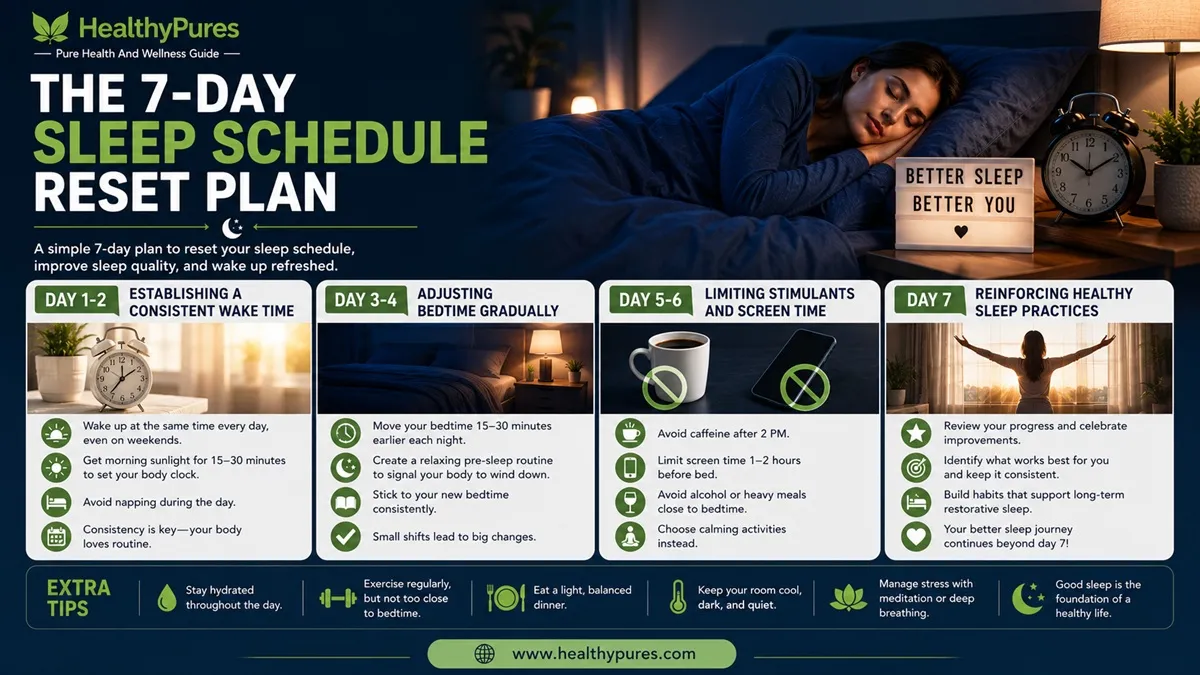
This plan organizes how to fix your sleep schedule into manageable steps. Each day builds on the same foundation rather than introducing a completely new routine.
| Day | Main Focus | Key Action |
|---|---|---|
| Day 1 | Anchor wake time | Choose a realistic wake time and get up at that time. |
| Day 2 | Reinforce daytime light | Get daylight after waking and keep your wake time steady. |
| Day 3 | Shift bedtime gradually | Move bedtime in small steps when your current timing is far off. |
| Day 4 | Strengthen sleep cues | Go to bed when sleepy and avoid long periods awake in bed. |
| Day 5 | Move caffeine earlier | Adjust caffeine timing if it is interfering with sleep. |
| Day 6 | Reduce evening stimulation | Dim bright light and choose calmer activities before bed. |
| Day 7 | Review and continue | Keep the habits that worked and continue them beyond one week. |
Day 1-2: Establishing a Consistent Wake Time
Choose your target wake time and get up around that time each day. This is a core step in how to fix your sleep schedule.
Spend time in daylight after waking when possible. Daytime light helps reinforce the timing signals that shape your sleep-wake cycle.
Do not compensate for a rough night by staying in bed for several extra hours. Give yourself enough total sleep opportunity while protecting your wake-time anchor.
Day 3-4: Adjusting Bedtime Gradually
If your bedtime is far from your target, move it gradually rather than forcing a dramatic jump. This supports how to fix your sleep schedule without forcing sleep.
Go to bed when you are sleepy, not simply because the clock reaches a specific minute. If you remain awake and frustrated, leave bed briefly.
The NHLBI insomnia treatment guide describes stimulus control as part of CBT-I. It includes leaving bed when you cannot sleep and returning when sleepy.
This principle can support how to fix your sleep schedule without turning bedtime into a struggle. Avoid clock-watching while you wait for sleep.
Day 5-6: Limiting Stimulants and Screen Time
Review when you drink coffee, tea, energy drinks, or other caffeine. NHLBI notes that caffeine effects can last up to eight hours.
If sleep is difficult, move caffeine earlier rather than assuming everyone needs the same cutoff. Your sensitivity and bedtime both matter.
Reduce bright screens and stimulating content during the hour before bed. A dimmer, quieter evening can support how to fix your sleep schedule.
For additional wind-down strategies, read our guide to falling asleep faster.
Day 7: Reinforcing Healthy Sleep Practices
On day seven, repeat the habits that felt most sustainable. This keeps how to fix your sleep schedule focused on habits you can continue.
Review your sleep diary rather than relying on one night’s impression. Look for patterns in bedtime, wake time, caffeine, naps, and daytime alertness.
Our bedtime routine guide offers more ideas for building a consistent evening sequence.
Common Mistake: Do not treat the seventh day as the finish line. The value of how to fix your sleep schedule comes from continuing the routine afterward.
Maintaining Your New Sleep Schedule

Maintenance is part of how to fix your sleep schedule, not a separate challenge. Sleep timing can drift again when weekends, travel, work, or stress change your routine.
Dealing with Setbacks
One late night does not erase your progress. Return to your usual schedule without trying to compensate with extreme bedtime changes.
If you are genuinely sleep deprived, allow enough opportunity for recovery sleep. The goal is consistency without ignoring your actual sleep need.
Using Naps Carefully
Naps can be useful, but late or long naps may make nighttime sleep harder for some people. NHLBI suggests earlier naps when nighttime sleep is difficult.
For adults who nap, NHLBI advises keeping naps to about 20 minutes. This is a practical option while learning how to fix your sleep schedule.
Incorporating Relaxation Techniques
A quiet routine can reduce the mental effort surrounding sleep. Reading, breathing exercises, gentle stretching, or a warm bath may help you wind down.
Relaxation should not become another performance test. Choose activities that make the evening calmer and easier to repeat.
When to Seek Professional Guidance
Persistent trouble falling asleep, staying asleep, or functioning during the day deserves professional attention. Snoring, breathing pauses, or excessive daytime sleepiness also need assessment.
NHLBI describes chronic insomnia as sleep difficulty occurring at least three nights weekly for more than three months. CBT-I is generally recommended as a first-line treatment.
If how to fix your sleep schedule strategies do not help, a healthcare professional can evaluate other causes. Shift-work disorder and circadian rhythm disorders may need specialized treatment.
Healthy Pures Tip: If you feel dangerously sleepy, avoid driving or other activities requiring sustained alertness. Sleepiness is a safety issue, not just an inconvenience.
Frequently Asked Questions
How Long Does It Take To Fix A Sleep Schedule?
There is no universal timeline. A seven-day plan can establish stronger timing cues, while larger shifts may take longer.
Consistency matters more than promising a fixed deadline for how to fix your sleep schedule. Medical sleep disorders can also change the timeline.
Can I Still Nap During A Sleep Schedule Reset?
Yes, but timing matters. If naps make nighttime sleep harder, keep them earlier and shorter.
NHLBI suggests adults who nap limit them to about 20 minutes. Shift workers may need a different approach.
What If I Cannot Fall Asleep At My New Bedtime?
Do not force sleep for a specific clock time. Go to bed when sleepy and leave briefly if wakefulness becomes frustrating.
This stimulus-control approach is also used within CBT-I. Keep your morning schedule as consistent as practical.
Should I Avoid Screens Completely Before Bed?
Not necessarily. Bright artificial light and stimulating screen use can interfere with winding down for some people.
Dim the display, reduce brightness, and choose calmer activities. The goal is a lower-stimulation evening, not fear of technology.
How Late Is Too Late For Caffeine?
Caffeine sensitivity varies. NHLBI notes that its effects can last up to eight hours, so late-afternoon caffeine can affect some sleepers.
Move your last caffeinated drink earlier if falling asleep is difficult. Track the result rather than relying on a universal cutoff.
Does Melatonin Fix A Sleep Schedule?
Melatonin is not a universal way to fix a sleep schedule. Timing, dose, medications, and the underlying sleep problem all matter.
The NHLBI circadian rhythm treatment guide notes that melatonin may be used for some circadian rhythm disorders. It is not a guaranteed solution for ordinary schedule drift.
NHLBI also notes that evidence does not establish melatonin as an effective treatment for insomnia. Discuss supplement use with a healthcare professional when appropriate.
Embracing Restful Nights
Learning how to fix your sleep schedule is mainly about strengthening reliable timing cues. A steady wake time, daytime light, sensible caffeine timing, and a calm evening routine provide a practical foundation.
Use the seven days to identify habits you can continue, not to chase a perfect sleep score. If problems persist, professional evaluation can help identify what a routine reset cannot address.
Disclaimer: This article provides general educational information and does not provide individualized medical advice. Read our full Medical Disclaimer for more information.